Classic Car Tires in Sacramento: What You Actually Need to Know
Finding the right classic car tires in Sacramento is one of those jobs that separates a tire shop from a real tire shop. We see it at both our Florin Road and Arden Way locations regularly - someone rolls in with a 1967 Camaro or a 1964 Impala and wants tires that look right, ride well on our local roads, and do not shred on the railroad crossings on Florin Rd or the expansion joints on Business 80. Getting there takes more than punching a size into a computer. It takes knowing the history of these platforms, the limitations of their suspension and brake geometry, and which modern products actually bridge the gap between period-correct appearance and safe, driveable performance in 2026.
Sacramento is a surprisingly strong classic-car town. The dry summers - routinely 100F and above from July through October - preserve body panels and keep rust at bay. The Delta breeze rolls in through the evening and cools things off enough for weekend drives down Freeport Blvd or out toward Fair Oaks and Carmichael. Cruise nights pop up around Elk Grove and along Arden Way. The result is a lot of well-preserved iron that needs proper rubber, and owners who care deeply about getting the details right.
Bias-Ply vs Radial Tires on Classic Cars
This is the first question almost every classic-car owner asks, and the honest answer is that most people should run radials - but you need to understand why, and you need to confirm your suspension is set up for them.
Bias-ply tires were original equipment on virtually everything built before the mid-1970s. The cord plies run diagonally across the tire at 30 to 40 degree angles. They give the sidewall a rounded, balloon-like profile that looks period-correct, they work with the original suspension geometry tuned around their stiffer sidewall flex, and on a true show car or a trailer queen they are the authentic choice. The downsides are real though: bias-ply tires run hot at highway speed, they wear faster, they have dramatically less traction in wet conditions, and handling is soft and vague compared to any modern radial. In Sacramento's rainy season - December through March, with Tule fog making Stockton Blvd and Highway 99 genuinely treacherous some mornings - that wet-traction deficit is not trivial.
Radial tires have steel or fabric belts running perpendicular to the direction of travel beneath the tread, giving a much flatter contact patch and far superior grip, heat dissipation, and longevity. The overwhelming majority of Sacramento classic-car owners who actually drive their cars choose modern radials. The trade-off is handling that can feel slightly more sensitive on original suspension geometry that was dialed in around the stiffer bias-ply sidewall, and a slightly different sidewall profile that a judge at a concours show will notice. For 95% of drivers, that trade-off is easy to make.
One thing to watch: if your car still has the original drum brakes all around, radial tires will stop your car noticeably shorter and more abruptly than bias-plys did. That is a good thing, but it means you need to drive with that improved stopping distance in mind - do not ride someone's bumper expecting 1968 braking distances.
Whitewall, Redline, and Raised-Letter Classics
The visual signature of a classic tire matters as much to most owners as the performance spec. Here is what is available in modern radial construction:
Whitewall tires are the most requested. Wide whitewalls (roughly 2.5 inches) suit pre-1960s vehicles - think 1955-1957 Bel Airs, early Impalas, 1957 Chevrolets. Narrow whitewalls (about 1 inch) are more period-correct for the 1960s muscle era. Coker Tire and Diamondback Classics are the go-to suppliers for authentic whitewall radials in original sizes. Prices run $175-$280 per tire depending on size and width, which is a step up from standard all-season tires, but the visual payoff on a Land Park show car is worth every dollar.
Redline tires are the muscle-car look: a thin red pinstripe on the outer sidewall. The 1960s Pontiac GTO and early Mustang crowds especially want these. Coker makes redline radials in period sizes. Budget $180-$260 per tire.
Raised white letter (RWL) tires are the late-1960s through 1970s look - big letters spelling out the brand name in white on the outer sidewall. This is what a 1969 Camaro SS or a 1970 Chevelle LS6 had from the factory. BF Goodrich, Firestone, and Mickey Thompson all make modern raised-letter tires in muscle-car sizes. These are often the most affordable option, ranging from $100-$180 per tire in popular sizes, and they look absolutely correct on the right application.
Period-Correct Sizes and Their Modern Equivalents
Classic cars use sizing systems that look nothing like modern metric sizing, and this trips people up constantly. Here is a quick reference for the most common Sacramento classics we see:
| Vehicle | Period Size | Modern Radial Equivalent |
|---|---|---|
| 1964-1966 Ford Mustang | 6.95-14 | 205/75R14 or 215/70R14 |
| 1967-1968 Ford Mustang (base) | E70-14 | 215/70R14 |
| 1969-1970 Ford Mustang Mach 1 | F70-14 | 225/70R14 |
| 1967-1969 Camaro (base) | E70-14 | 215/70R14 |
| 1969-1972 Camaro SS/Z28 | F70-14 or E60-15 | 225/70R14 or 225/60R15 |
| 1966-1972 Chevelle | F70-14 or G70-14 | 225/70R14 or 235/70R14 |
| 1958-1964 Impala | 8.00-14 | 225/75R14 or 235/75R14 |
| 1955-1957 Bel Air | 6.70-15 | 205/75R15 |
The letter-number alphanumeric system (E70-14, F70-14, G70-14) works roughly like this: the letter indicates load range and approximate width (E is narrower, G is wider), the two-digit number is the aspect ratio, and the number after the dash is rim diameter in inches. An F70-14 is a tire with an aspect ratio of 70, fits a 14-inch rim, and is one width-step wider than an E70-14. Converting to modern metric sizing for a given application requires cross-referencing the original overall diameter so your speedometer stays accurate and the tire fills the wheel well correctly.
One note specific to Sacramento drivers: if you are taking your classic over I-80 to Tahoe for a summer show or a fall cruise, pay attention to overall tire diameter. A taller tire keeps your engine RPM down at 65 mph, which matters on those long mountain grades. Check out our guide to reading tire size specifications for a full explanation of how aspect ratio and diameter math works.
Wheel Options for Classic Cars
The wheel choice on a classic build says as much about the owner as any other single decision. There are three main directions people go, and each has real fitment implications.
Restored Steel Wheels With Hubcaps and Trim Rings
This is the fully correct restoration path. Original steel wheels sandblasted, primed, and painted body color or argent silver, fitted with reproduction hubcaps and trim rings. For a show-quality 1957 Bel Air or a driver-grade 1965 Impala, nothing beats the look. The practical challenge is that original steel wheels are often out-of-round after 60 years, and rim seating surfaces that were never intended for modern radial tires can leak air at the bead. We can true up steel rims on our mounting equipment, but severely bent or pitted rims sometimes need to be replaced with reproduction stampings. Expect to pay $40-$80 per rim for straightening and bead cleaning, plus whatever the hubcap reproduction costs - factory-style full caps for a 1957 Chevy run $80-$150 each for decent quality.
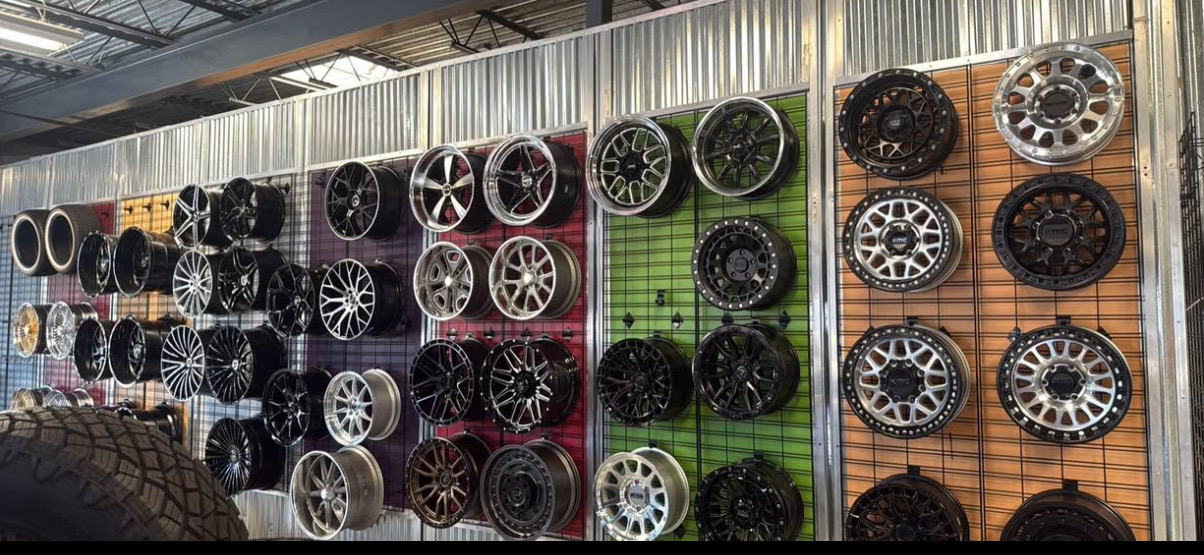
Cragar S/S Wheels
The Cragar Super Sport is the defining 1960s-1970s muscle-car wheel: 5-spoke chrome steel with a polished lip. A 1969 Chevelle on 14x7 or 15x7 Cragar S/S wheels looks exactly right and turns heads on every cruise night in Elk Grove or on Arden Way. Cragar still makes these. A set of four 14x7 S/S wheels runs around $400-$600 - very reasonable for the visual impact. They are also heavy, which matters if you care about unsprung weight and handling, but on a cruiser or a street/strip car the aesthetics win the argument.
American Racing Torq Thrust and US Mags
The American Racing Torq Thrust D is arguably the most iconic American muscle wheel ever made - five swept spokes, classic dish, available in cast aluminum with polished lip or full matte finish. Fits Mustangs, Camaros, Chevelles, and Mopars equally well depending on bolt pattern. A set of four in 15x7 or 15x8 runs $600-$900. American Racing also makes the original Torq Thrust in several diameters if you want to go up to a modern 17-inch or 18-inch wheel while keeping the vintage look.
US Mags makes premium billet aluminum versions of retro designs - the Indy, the Rambler, the Standard - with better fitment precision and more offset options than cast wheels. These run $200-$400 per wheel and are increasingly popular on high-dollar Sacramento builds where the owner wants a period look with modern precision. We carry and mount US Mags at both locations.
Classic Car Fitment Challenges in Sacramento Shops
This is where experience matters. Classic vehicles present fitment challenges that a shop used to running modern cars on a computer database will get wrong. We have seen the results - rubbing on frame rails, contact on drum-brake backing plates, incorrect backspacing causing tire lean - and fixing those mistakes is expensive.
Narrow Bolt Patterns
Most 1960s and early 1970s American cars use one of two bolt patterns: 5x4.5 (127mm), which covers Ford/Mercury/Mustang/early Bronco, and 5x4.75 (120.65mm), which covers most GM A-body, B-body, and F-body cars - Chevelles, Impalas, Camaros, Firebirds. These are narrow patterns by modern standards, which means many aftermarket wheels that list compatibility will have poor centering or require careful hub-centric ring fitment. We verify bore diameter and use proper hub rings on every classic-car wheel mount we do. Do not let a shop skip this step - it causes vibration at speed that gets blamed on tire balance, and the real fix is proper wheel centering.
Backspacing and Drum-Brake Clearance
Older vehicles with drum brakes have large cast-iron backing plates that sit inside the wheel. The backspacing (depth from the wheel mounting face to the inner edge of the barrel) must be calculated precisely or the wheel and tire contact the drum assembly. On a typical 1960s GM B-body like an Impala or full-size Chevrolet, you generally need 3.5 to 4.25 inches of backspacing on a 14 or 15-inch wheel. Going lower than 3.5 inches throws the wheel out dramatically and makes the car look like a lowrider regardless of your intentions. Going higher than 4.5 inches risks contact with the backing plate under suspension travel. Our wheel offset and backspacing guide explains the geometry in detail.
We always mock up a wheel and rotate it through full suspension travel before completing any classic-car wheel fitment job. It adds 30 minutes to the process and is absolutely worth it.
No TPMS
Pre-2008 vehicles were never required to have tire pressure monitoring systems. Classic cars have none. That puts the responsibility on the owner to check pressure regularly - critical because a radial tire on a classic does not always look obviously low even when it is significantly under-inflated. Under-inflation on a heavy-cruiser application at Sacramento summer temperatures (100F+ ambient, pavement surface temperature much higher) will cook a tire from the inside. Check pressure cold, once a week on any car you drive regularly, and before any trip up I-80 toward the Sierra.
We strongly recommend a quality analog or digital gauge rather than relying on visual inspection. Good pocket gauges cost $12-$20 and last for years.
Sacramento Classic Car and Cruise Scene
Sacramento has a legitimate classic-car culture, and the tire and wheel choices made at shops like ours roll through it every weekend. The Elk Grove cruise nights draw a solid mix of 1950s lead sleds, 1960s muscle, and 1970s malaise-era survivors. Old Sacramento occasionally hosts shows along the river. Fair Oaks and Carmichael have informal meets in parking lots that feel more like the old days than the big organized events.
What we notice at those events is that the cars people remember - the ones that get photographed and talked about - are almost always the ones where every detail was done correctly. The right tire profile, the right wheel dish, the right backspacing so the wheel sits flush in the opening. That comes from working with a shop that has done enough of these builds to understand the geometry and the history, not just the computer database entry.
We have fitted tires and wheels on everything from a driver-quality 1968 Camaro RS that a guy bought 15 years ago and drives to work twice a week, to a frame-off 1957 Bel Air that took three years to restore and shows on weekends. The approach differs - the knowledge base behind it is the same. For more on the full scope of classic-car work we do, see our detailed guide to classic car restoration in Sacramento.
Frequently Asked Questions
Can I run modern radial tires on my classic car without modifying the suspension?
In most cases, yes. Radial tires are a direct drop-in replacement for bias-ply tires on most 1960s and 1970s American vehicles as long as you match the overall diameter closely. Some owners of early classic cars with very soft spring rates notice slightly different handling feel because radial sidewalls flex differently than bias-ply. If the car has been sitting for years, inspect all bushings, ball joints, and wheel bearings before putting any new tires on - worn suspension components will eat tires of any type very quickly.
What is the best tire for a 1969 Camaro SS that I drive on weekends and take to shows?
For a dual-purpose show-and-drive Camaro SS, BF Goodrich Radial T/A in 225/70R14 or 235/60R15 depending on your wheel diameter gives the most period-correct raised-white-letter look in a modern radial construction. If you want the absolute best grip for canyon roads and occasional track days, look at the Coker Classic or a performance-biased tire in the same size range. Either way, we recommend having alignment checked after any new tire install on a classic - original factory specs are often unavailable and the car needs to be set to the best modern equivalent.
How do I know what backspacing I need for aftermarket wheels on my classic car?
Measure your existing wheel: lay it face-down, place a straightedge across the barrel, and measure from the straightedge down to the mounting face. That is your current backspacing. Most classic GM applications run 3.75 to 4.25 inches; Ford applications vary more by year and model. When changing wheel width - say going from a 6-inch-wide stock wheel to a 7-inch-wide aftermarket - you need to recalculate because wider barrels at the same offset change how the wheel sits relative to the fender and frame. Bring your vehicle in and we will take measurements and confirm clearance before ordering wheels.
Are classic car tires available for same-day installation in Sacramento?
Popular sizes like 215/70R14, 225/70R14, and 205/75R15 are often in stock or available for next-day delivery from our distributors. Specialty whitewalls, redlines, and narrow sizes like 6.70-15 for a 1950s vehicle may require 3-7 business days to source. Call us at either location before coming in and we will confirm availability and give you an honest timeline. Visit our locations page for full contact details and hours.
Do you do wheel alignment on classic cars with older front-end geometry?
Yes. Classic cars with kingpin or ball-joint front ends can be aligned on our equipment as long as the front-end components are in serviceable condition - worn tie rods, ball joints, or idler arms will not hold an alignment regardless of how well the specs are set. We align to best available modern specs for the platform since factory specs from 60 years ago were designed around bias-ply tires and driving conditions of that era. Proper alignment extends tire life significantly and makes the car track straight, which on a classic that you drive on I-5 or Highway 50 is genuinely important for safety.
Can I finance classic car tires and wheels at Tire Geeks?
Yes - our Acima lease-to-own financing program covers the full ticket including tires, wheels, and installation labor. No traditional credit check, roughly 60-second application, and a 90-day same-as-cash early payoff option with no penalty. A full set of retro wheels and period-correct tires on a classic project does not have to be an all-at-once cash expense. Many of our classic-car customers use financing to do the job correctly rather than buying the cheapest option that almost fits.
Get Your Classic Fitted Right at Tire Geeks
Classic car work is a specialty, and we take it seriously at both Tire Geeks locations. Whether you are sourcing whitewalls for a 1957 Bel Air, fitting Torq Thrust wheels on a Chevelle, or working through the backspacing math on a first-generation Mustang, we have the experience and the inventory connections to do the job correctly. We also handle alignment, brake inspection, and all the suspension checks that make classic tires last and perform as they should. Check out our full service offerings and feel free to bring the car in so we can look at it before committing to a specific wheel or tire choice.
Come see us at 3020 Florin Rd, (916) 800-8786 (South Sacramento) or 2245 Arden Way, (916) 913-8786 (Arden area). Open Monday through Saturday, 9 AM to 6 PM. Walk in today - no appointment needed. If you want to talk through your build before you come in, reach out through our contact page and we will get back to you fast.
For more on how we approach custom wheel fitment for all types of builds, see our guide to custom wheels in Sacramento.